Strengthening OT Cybersecurity Through Immersive Industrial Network Training


A Global 500 manufacturer identified a need to strengthen OT cybersecurity and industrial network architecture across its facilities. To address increasing cyber threats and modernize plant networks, the company partnered with GPA to upskill process control managers and OT professionals. GPA delivered a five-day immersive program on Industrial Network Architecture & OT Cybersecurity, equipping participants with practical skills to design secure, resilient networks. The program was hosted at Louisiana Tech University in collaboration with the Honors College and Innovation Enterprise Center.
The Challenge
The company’s OT teams face evolving cyber threats and increasing network complexity. Ensuring consistent architecture, segmentation, resiliency, and secure remote access across multiple plants requires a unified understanding of best practices. Leadership needed a structured, hands-on training program aligned with industry standards such as the NIST cybersecurity framework, NIST SP800-82 and ISA/IEC 62443 to build internal capability and protect critical systems.
GPA's Solution
GPA designed a customized five-day instructor-led course on industrial network architecture and OT cybersecurity, built on industry best practices and GPA’s experience in ICS security and networking. The curriculum leveraged recognized industry modules were tailored to the customer’s needs. It guided participants from OT security fundamentals to advanced network design. Key features included:
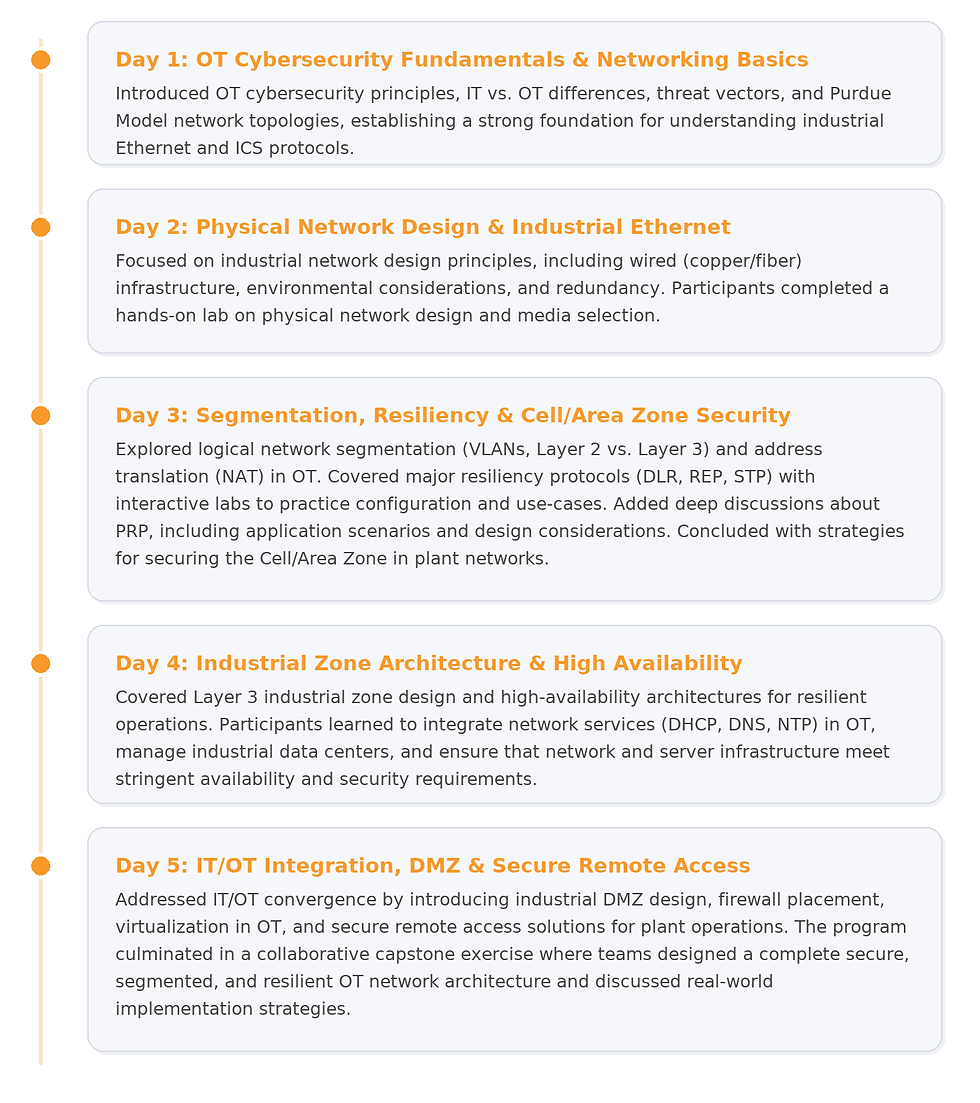
Comprehensive Curriculum Progression: The program covered OT cybersecurity threats, industrial networking fundamentals, segmentation, resiliency protocols, IDMZ design, IT/OT integration, and remote access best practices. Each day built on prior concepts to form a cohesive framework.
Hands-on Lab Exercises: Labs simulated real-world OT scenarios and provided hands-on experience configuring and validating DLR, REP, and STP protocols. Participants also engaged in in-depth discussions of PRP concepts, architecture, and applications in high-availability industrial networks.
Expert Instructors and Tailored Content: GPA instructors with extensive ICS field experience delivered the program. They used practical examples and interactive discussions tied to the customer’s operations. Content referenced the company’s existing network architecture to ensure relevance.
Focus on Best Practices & Standards: Training emphasized alignment with ISA/IEC 62443, NIST ICS guidelines, and Rockwell reference architectures. Participants applied the Purdue Model and learned high-availability design and secure remote connectivity practices.
Program Delivery
GPA delivered the five-day program on-site at Louisiana Tech’s University Hall. The instructors were Scott Timmer, Director of OT Infrastructure & Cybersecurity Services and Scott McNeil, Industrial Network & Security Architect II. Scott Timmer brings more than 30 years of experience in industrial controls, OT architecture,
and ICS cybersecurity. Scott McNeil specializes in industrial networking and wireless design and has nearly a decade of hands-on OT implementation experience.
Together, they grounded each topic in practical field examples, connecting secure network architecture principles directly to plant-floor realities. Over the week, participants from multiple facilities progressed through a structured mix of classroom instruction and hands-on labs. This reinforced best practices for secure, resilient, and scalable OT network design within a collaborative, campus-based learning environment.
Outcomes
By the end of the immersive program, the manufacturer’s team achieved measurable skill development:
Strengthened OT cybersecurity expertise: Participants gained a solid understanding of OT cybersecurity, including threats, standards, and mitigation strategies. They can now clearly explain key principles and improve cybersecurity awareness for their facilities.
Designing secure, segmented networks: Trainees learned to design industrial networks aligned with the Purdue Model, including defined Cell/Area Zones, Industrial Zones, and DMZ layers. This supports consistent segmentation and reduced attack surfaces.
Hands-on proficiency with resiliency protocols: Through hands-on labs and demonstrations, participants configured and validated Device Level Ring (DLR), Rapid Ethernet Protocol (REP), and Spanning Tree Protocol (STP) networks. They gained practical experience building fault-tolerant industrial network architectures and troubleshooting network disruptions, developing skills they can apply to improve system uptime, availability, and reliability. Participants also gained a deeper understanding of Parallel Redundancy Protocol (PRP) through detailed discussions of its architecture, operation, and applications in high-availability industrial networks.
Reference architectures & best practices: GPA provided reference architectures aligned with Rockwell best practices. These templates support future upgrades and ensure consistency with industry standards.
Value Delivered
The immersive training program has delivered significant business value and set the stage for improved OT network security and performance:
Empowered OT workforce: Teams returned with stronger knowledge, practical skills, and a shared understanding of cybersecurity and network design. This enables more consistent implementation of security practices across plants.
Improved network reliability and security: The company is better positioned to reduce downtime and mitigate cyber risk through segmentation and high-availability design. Networks can be re-architected to limit failures and contain incidents.
Operational and strategic impact: Improved IT/OT integration and secure remote access support digital initiatives such as remote monitoring and predictive maintenance, while maintaining strong security controls.
Culture of continuous improvement: The program fostered ongoing cybersecurity awareness and best practices. Participants are now driving continuous improvements in network management and risk reduction.
Conclusion
This five-day immersive program addressed the customer’s challenge by delivering a comprehensive blend of classroom instruction, practical labs, and real-world design exercises, all tailored to the client’s environment and objectives. The result is a more knowledgeable and prepared OT team, armed with the skills and confidence to implement secure, resilient industrial network architectures across the enterprise. The case exemplifies how GPA’s tailored educational programs can drive immediate workforce development and long-term operational benefits – empowering companies to protect their critical infrastructure and pursue digital transformation with greater security and assurance. The collaboration with Louisiana Tech University further underscores GPA’s innovative approach to partnering for success and advancing the state of OT cybersecurity skills in today’s industrial landscape.


